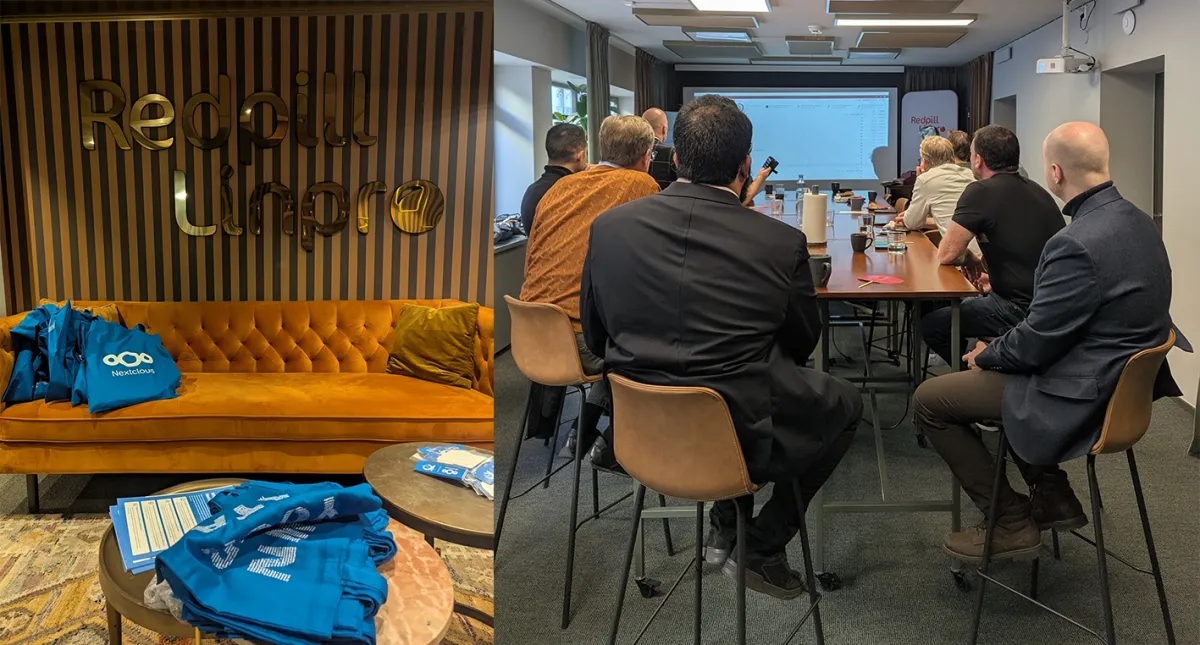
1. European alternatives exist, but dependence on Microsoft remains high
Almost every organisation represented at the event used Microsoft or Google as its collaboration platform. Some had started exploring Nextcloud, while one organisation was already using it. At the same time, almost all participants agreed that mature European alternatives with strong functionality are already available. When asked whether their organisations would be significantly less dependent on Microsoft in five years, a clear majority believed they would.
This highlights an interesting gap between ambition and reality. There is a willingness to explore alternatives, but that does not mean the transition will be straightforward. One challenge raised was the extent to which organisations have built integrations and business processes around Microsoft's ecosystem over many years. Every additional integration and dependency can make a future transition more complex.
Digital sovereignty is therefore not just about which technological alternatives are available today. It is also about ensuring that today's technology choices do not restrict tomorrow's freedom to act.
2. User acceptance can determine whether a migration succeeds
When participants discussed potential barriers to change, the main concerns were not technical implementation or security requirements. Instead, the conversation repeatedly returned to the people who would be using the new platforms. Almost all participants considered user acceptance essential to a successful migration.
One participant offered a different perspective, arguing that users need to adapt to the solution that best meets the organisation's requirements for control and security. There was, however, broad agreement that alternative platforms must offer sufficient quality and meet the functional needs of the business.
Implementing a working platform is only part of the challenge. Organisations also need to explain why the change is happening, involve the business, train users and give them the support they need to adapt their ways of working.
Several participants felt that change management still receives too little attention in IT projects. This raises an important question: are we focusing too much on implementing new systems and not enough on ensuring that people actually adopt them?
3. A failed migration can create new risks
During one of the exercises, we asked participants to imagine a scenario in which their organisation's transition towards a more sovereign digital workplace had failed five years from now. What had gone wrong?
One scenario involved an organisation migrating away from Microsoft or Google, only to find that users were dissatisfied with the new platform. Without sufficient governance, training and change management, employees begin finding their own solutions.
Shadow IT grows, and the organisation risks eventually returning to its previous platform. This scenario highlights an important risk. A technically completed migration is not necessarily a successful one. If users do not embrace the change, the organisation may face new challenges involving security, control and information management — precisely the areas the transition was intended to improve.
Change management cannot simply be added at the end of a migration project. It needs to be part of the strategy from the outset.
4. Digital sovereignty does not stop at organisational boundaries
Another interesting topic was collaboration between organisations. One participant raised the challenges faced by municipalities that work together. Even if one municipality decides to adopt Nextcloud, what happens if its partners continue using Microsoft? Will collaboration become more difficult? Could the organisation feel pressured to use the same platform as its partners?
This illustrates that dependencies do not exist only within an organisation's own IT environment. They also exist between organisations. Digital sovereignty therefore needs to go hand in hand with interoperability: the ability to collaborate, share information and communicate across different technology platforms.
The goal does not have to be for every organisation to use the same solution. Instead, organisations should be able to make their own technology choices without compromising their ability to work together.
5. Document templates and workflows: small details with a big impact
During the morning, participants heard real-world examples from organisations that had already taken steps towards more digitally sovereign workplaces. They particularly appreciated that the presentations covered not only the results but also the challenges encountered along the way.
Many questions focused on document management, existing templates and documents that had been developed over many years within Microsoft's ecosystem. At first glance, this might seem like a minor issue. After all, an old document template can be rebuilt. But larger organisations may rely on hundreds or even thousands of templates, complex documents and established workflows that employees depend on every day. Something that is technically possible can still require considerable effort and adaptation.
This is where early testing with real users becomes essential. Which documents and workflows are business-critical? What works straight away? What needs to be adapted? By involving the business early, organisations can identify challenges before they affect the wider organisation.
6. Digital sovereignty comes at a cost — but what is the cost of losing the freedom to choose?
Cost was another topic raised during the discussions. One participant pointed out that migration requires an initial investment and that any savings may take time to materialise. At the same time, several participants emphasised the importance of control and security. This highlights that choosing a digital platform involves much more than comparing licence costs.
It is also about reducing vendor dependency, maintaining control over data and creating the flexibility to adapt the digital environment as needs change.
The discussion also touched on the importance of exit plans and, crucially, testing them in practice. Having a documented exit plan is a good starting point. But only by testing the ability to leave a vendor can an organisation identify the dependencies and challenges involved.
Putting an exit plan to the test provides a more realistic understanding of an organisation's freedom to act and what it would take to make a future transition possible.
7. The next 90 days: turning ambition into action
We ended the roundtable by asking participants a final question:
What will you do over the next 90 days to make your organisation more digitally sovereign?
The answers focused primarily on raising awareness internally, sharing knowledge about alternatives to Microsoft and Google, engaging more colleagues and exploring the possibility of running a proof of concept. Perhaps this was one of the most important takeaways from the morning.
Moving towards digital sovereignty does not have to start with a decision to replace the entire digital workplace. It can begin by mapping existing dependencies, testing an alternative in a limited area, involving users or checking whether the organisation's exit plan actually works.
The important thing is to start creating room to manoeuvre.